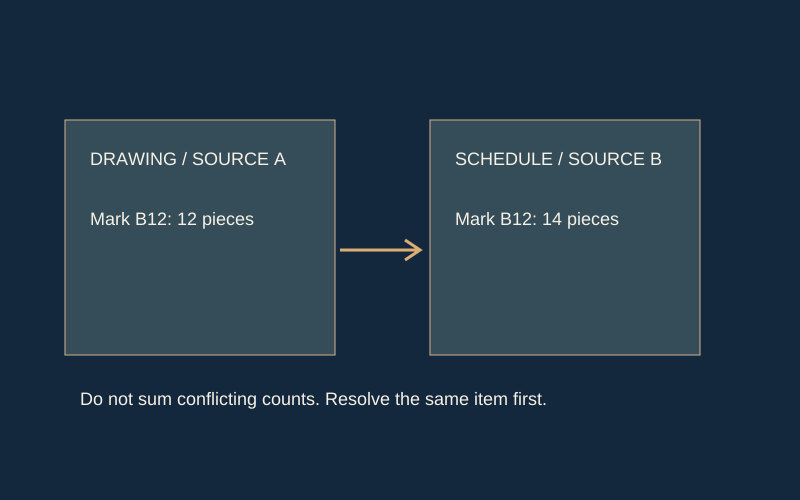
- Hypothetical source A lists 12 pieces and source B lists 14 for the same mark.
- Do not merge the two into 26; retain both references and resolve the discrepancy.
- Source revision, scope and reviewer decision belong with the quantity record.
Define a stock group
A stock group should share material identity, grade, treatment or finish, actual cross-section and required appearance characteristics. The one-dimensional planner assumes every stock board within a run can produce any part in that run. If that assumption is false, the mathematical schedule can be unusable even when every length fits.
Avoid hidden substitutions
Do not let a label like “rail” conceal a different thickness or supplied profile. List the exact stock group on the exported record. When two boards have the same nominal label but different actual widths, preserve those dimensions independently. The general tool does not resolve product substitutions or assess compatibility.
- Make a separate run for each non-interchangeable group.
- Keep stock length availability specific to that group.
- Combine only the final purchasing summary.
Reconcile totals by unit
Linear footage can be added for logistics, but that aggregate cannot describe the full purchase specification. Board count, face area and physical volume should remain traceable to the individual stock groups. A combined number is useful only when its purpose is clear; it must not replace the detail needed to order the right material.
Worked planning example
An assembly needs 5/4 appearance boards and 2-inch framing members. Even if both are available in 12-foot lengths, they belong in separate cut plans. Combining them could assign a framing part to appearance stock solely because a remainder looks large enough.
Common questions
Can I mix widths in the cut planner?
No. Run each cross-section separately. It does not model ripping or two-dimensional nesting.
What if two species have identical dimensions?
Keep them separate unless the design and purchase requirements explicitly make them interchangeable.
Evidence & limits
- Calculation method: dimensional arithmetic and conservative first-fit packing
- NIST PS 20-25 — measurement, tally and softwood size basis
Reviewed September 13, 2026. Sources support their stated technical principles; this site's workflows and hypothetical examples are not product tests, supplier approvals or independently reviewed project records.