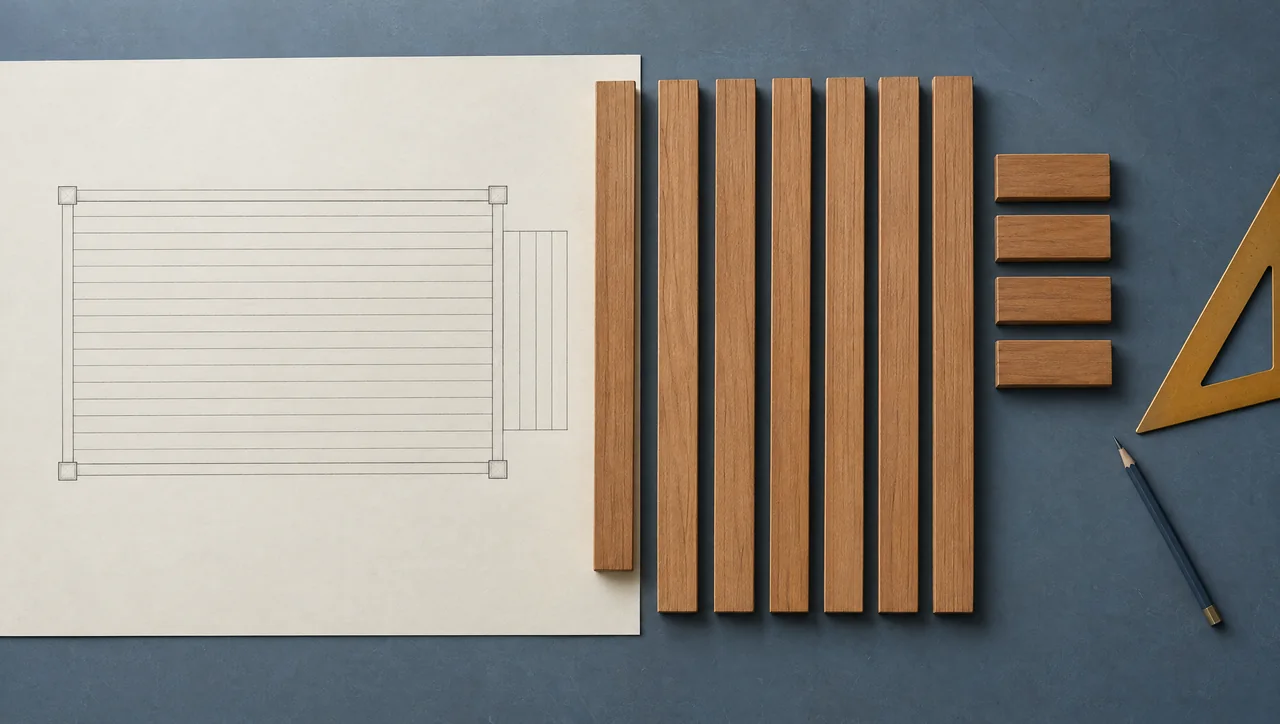
Translate a project plan into a clear list of material parts.
Illustrative estimating scene. Use the source drawing, stated dimensions and calculation method for quantities.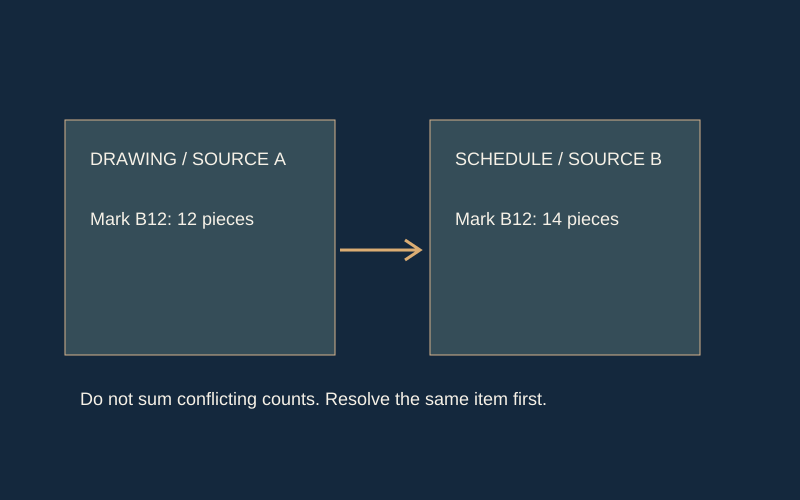
- Hypothetical source A lists 12 pieces and source B lists 14 for the same mark.
- Do not merge the two into 26; retain both references and resolve the discrepancy.
- Source revision, scope and reviewer decision belong with the quantity record.
One row, one definition
Combine pieces only when their material, cross-section, finished length and appearance requirements are genuinely interchangeable. Two rails of identical length may still belong in separate lists if one has a finished edge or a different grade. The linear planner assumes all parts in one run can be cut from the same stock type.
- Record label, finished length and whole quantity.
- Keep a drawing or sketch reference outside the calculator.
- Split unlike material or cross-section into separate runs.
Choose a consistent dimension basis
Enter dimensions in either inches or millimetres. The unit switch converts the existing values; it does not simply relabel the fields. Lengths should represent the part required by the design. If a fabrication process needs extra machining allowance, decide and document that allowance before entering the part length.
Make changes legible
A revised list should indicate which part changed and why. Export the old result before editing so the purchasing record can be compared. Working calculator inputs are temporary until you export or choose Save snapshot. Private takeoff projects retain saved revisions and autosave edits after a short pause; confirm the Saved status before leaving. Avoid putting personal details into part labels, since those labels travel with exported files.
Give each row a source and a material identity
A useful parts row can be traced in both directions: back to the drawing that requires it and forward to the stock from which it will be cut. Keep the part label stable when a dimension changes. Add the revision separately so a changed part does not disappear under a new name.
A practical source reference names the drawing or sketch, its revision, and the detail or location. “From plans” is too vague to resolve a later disagreement. Record whether the stated length is a finished requirement or a fabrication blank that already contains an allowance; otherwise the person preparing the cut plan may add the same allowance twice.
| Field | Illustrative entry | What it prevents |
|---|---|---|
| Part label | R-01 | Confusing two similarly sized parts |
| Location | Entry assembly, upper rail | Losing the physical purpose |
| Source | Sketch S-02, revision B, detail 3 | Using an obsolete dimension |
| Stock group | Group A — visible rails | Mixing non-interchangeable material |
| Finished length and quantity | 44 in × 4 | Treating total length as a piece schedule |
| Allowance basis | Finished length; cutting allowances separate | Double-counting trim or machining |
| Review state | Source dimension checked; stock availability pending | Treating an incomplete list as released |
Identical lengths do not make interchangeable parts
Suppose four visible rails and two concealed braces are all 36 inches long. Combining them as six pieces loses information if the rails need a different grade, profile, finish or edge treatment. Keep separate stock groups wherever those requirements differ. Within each group, parts may share a cutting run only if the selected stock can actually satisfy each part.
Do not divide a total of 216 finished inches by a stock length and call that the purchase list. Six required pieces still have to fit as six pieces after the stated cuts and trimming. A length total is useful for reconciliation; it does not prove a feasible cutting arrangement. The mixed-material guide explains how to keep unlike stock separate.
Reconcile pieces before optimizing waste
Check every source part against the list once for inclusion and once for duplication. Repeated drawing views may show the same physical piece. Conversely, one detail may apply at several locations. State the repetition factor and identify the locations instead of assuming the number of drawing symbols equals the number to buy.
Then reconcile the totals by stock group: part quantity, finished length, stock quantity and stated losses. If a group disappears during editing, these checks make the omission visible. Keep deliberately excluded work in the scope note so another estimator can distinguish “not required” from “not yet counted.”
For a comma-separated planner, a label such as R-01 Entry rail is safer than one containing a comma. Check the imported row count and units before generating a pattern. Inspect the exported labels and quantities as well: an input accepted by the page is not yet a reviewed fabrication record.
Worked planning example
Suppose a project uses four visible rails and two concealed braces, all 36 inches long. If the rails require a better appearance grade, they are not six interchangeable parts. Run the rail and brace lists separately and identify both stock specifications in the purchase record.
Common questions
Can labels contain commas?
The current planner uses comma-separated input with three fields per line. Avoid commas in labels; use a hyphen or space.
Does changing the unit erase my plan?
The unit switch converts stock, kerf, trim and part lengths together. Review rounding and exported units before fabrication.
Evidence & limits
- Calculation method: dimensional arithmetic and conservative first-fit packing
- NIST PS 20-25 — measurement, tally and softwood size basis
Reviewed September 13, 2026. Sources support their stated technical principles; this site's workflows and hypothetical examples are not product tests, supplier approvals or independently reviewed project records.