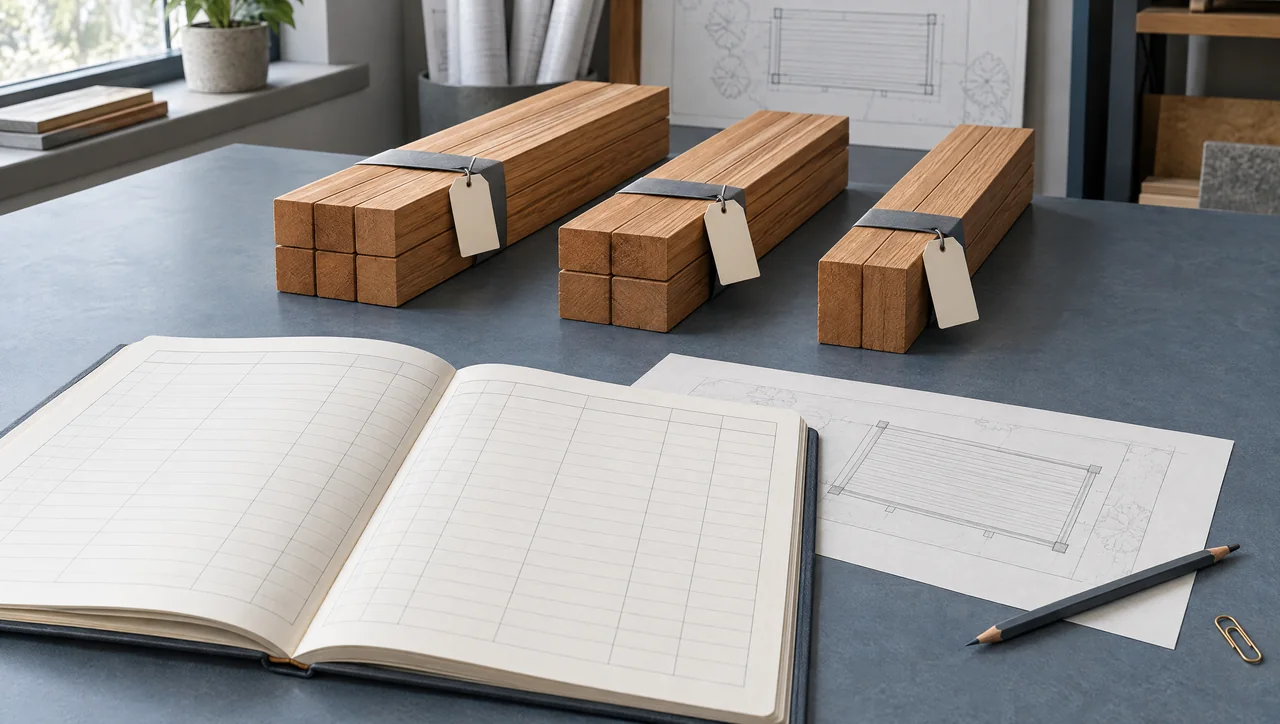
Keep stock quantities, purchase records and the takeoff together.
Illustrative estimating scene. Use the source drawing, stated dimensions and calculation method for quantities.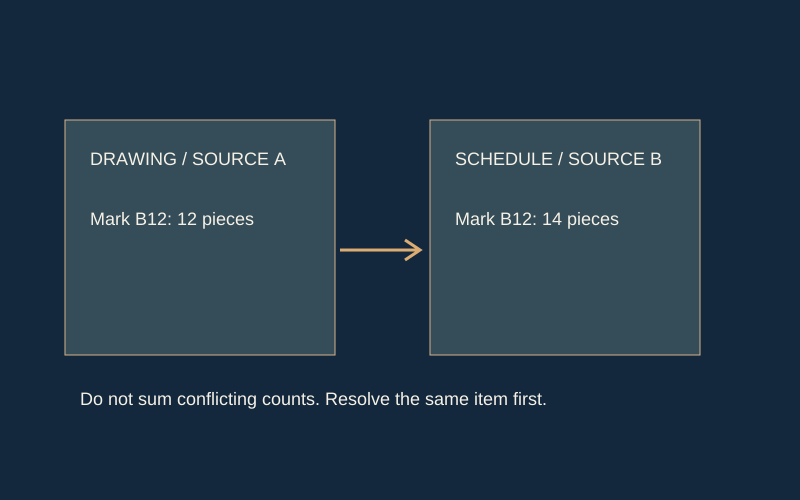
- Hypothetical source A lists 12 pieces and source B lists 14 for the same mark.
- Do not merge the two into 26; retain both references and resolve the discrepancy.
- Source revision, scope and reviewer decision belong with the quantity record.
Specify more than a count
A purchase line should identify species or product, grade, profile, actual dimensions, nominal description where relevant, stock lengths and quantity. Add any documented finish, machining or appearance requirements. If availability forces a change, return to the cut plan rather than assuming an equivalent total footage will work.
Ask the questions the calculator cannot answer
Confirm tally basis, minimum quantities, length tolerances, sorting, packaging, freight scope and what is excluded. The site does not supply live prices, stock or delivery promises. A material inquiry is a request for information; it is not a purchase commitment or an accepted quote.
- Confirm quantities by stock group.
- State the design revision and measurement date.
- Separate spare stock from geometric cut losses.
- Record unresolved substitutions or dimensions.
Keep the handoff reviewable
Export the calculation and retain your own copy. The inquiry link can stage a shortened summary for review, but it does not send anything until a functioning form is explicitly submitted. A long cutting schedule belongs in your saved record; do not assume every row fits in a short inquiry summary.
Reconcile the order to the reviewed parts
Before issuing a purchase list, trace each stock group back to its parts and source revision. Separate net required material, explicit allowances, selected stock and known exclusions. The supplier should be able to tell whether a number is a finished-part total or the quantity to supply.
Check special roles separately: borders, edges, stairs, fascia and replacement stock can disappear when everything is reduced to area. Use the actual scope of the project; do not add categories that are not present merely to make a checklist longer.
Use a fictional reconciliation
| Quantity stage | Illustrative amount | Meaning |
|---|---|---|
| Net parts | 800 LF | Sum of reviewed finished parts |
| Selected stock | 880 LF | Proposed stock schedule |
| Difference | 80 LF | Must be explained by cut plan, trim, remainder or explicit allowance |
The 80 LF difference is not automatically waste. Some may remain as reusable stock; some may reflect the selected length mix. Keep the explanation so a later reduction does not remove material that the cutting plan actually needs.
Confirm profile, unit, length distribution and revision on the supplier request. When the quotation returns, compare the offered schedule with the requested one. A matching grand total can conceal a different assortment that no longer serves the parts.
Worked planning example
Instead of “96 feet of wood,” write twelve boards of the specified material and cross-section at the confirmed 8-foot stock length, followed by the grade, profile and tally basis. That lets the supplier discuss a substitution without guessing which part lengths must still fit.
Common questions
Is the result a quote?
No. It is a quantity record. Prices, availability, delivery and acceptance require a separate supplier response.
Should I send the nominal or actual size?
Include both when relevant, with labels. Actual geometry supports calculation; the trade description helps identify the supplied product.
Evidence & limits
- Calculation method: dimensional arithmetic and conservative first-fit packing
- NIST PS 20-25 — measurement, tally and softwood size basis
Reviewed September 13, 2026. Sources support their stated technical principles; this site's workflows and hypothetical examples are not product tests, supplier approvals or independently reviewed project records.