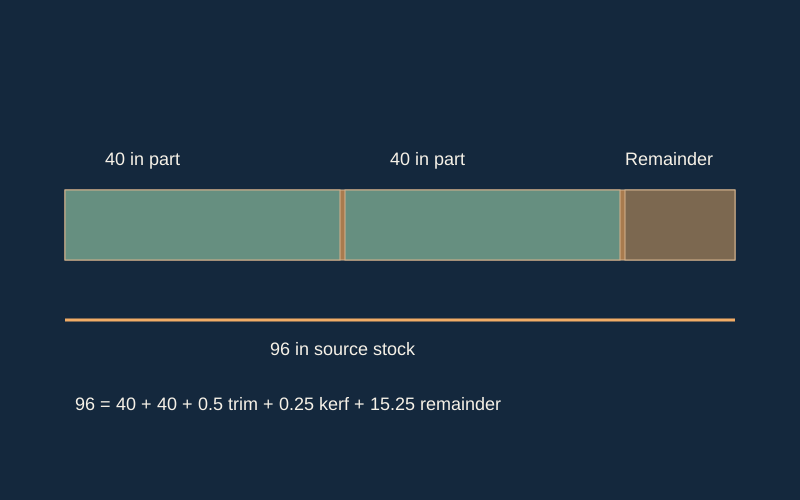
- Worked example: two 40-inch parts from 96-inch stock.
- After 0.5 inch total trim and 0.25 inch total kerf, 15.25 inches remain.
- Bars emphasize the parts; narrow cut losses are enlarged for visibility. Reuse depends on clear length and condition.
What the algorithm does
The planner sorts parts from longest to shortest. It places each part in the first existing board with enough usable length, opening another board when necessary. This first-fit decreasing approach is transparent and practical, but it does not search every arrangement. A feasible output is not proof that no better combination exists.
What it cannot see
The tool has no view of knots, checks, grain orientation, bow, damage, grade restrictions or required joint locations. It does not assess strength, fastening, safety or equipment setup. It also assumes a consistent stock length and cross-section within one run. Review the output against actual material and approved fabrication information.
- At most 500 parts are accepted per run.
- One conservative kerf is reserved per part.
- Only the first 30 board diagrams are displayed; the CSV includes all boards.
Use the result as a reviewable draft
Look for near-full patterns and identify parts that cannot be moved because of appearance matching. Compare a second stock length or manually explore a different pattern when the material cost justifies it. Keep the original input, formula assumptions and exported schedule together so another person can reproduce the result.
Worked planning example
Two patterns can produce the same number of finished pieces while leaving different offcut lengths. A shop expecting another short-part job may prefer fewer long offcuts to many tiny ones, even if the total leftover length is identical. The tool does not assign value to those future uses.
Common questions
Why not call it optimal?
The method is a heuristic, not an exhaustive optimization proof. “Cut plan” describes what is delivered more accurately.
Can I cut directly from the screen?
Have the person responsible for fabrication review dimensions, material condition and cutting allowances first. The output is not an equipment operating procedure.
Evidence & limits
- Calculation method: dimensional arithmetic and conservative first-fit packing
- NIST PS 20-25 — measurement, tally and softwood size basis
Reviewed September 13, 2026. Sources support their stated technical principles; this site's workflows and hypothetical examples are not product tests, supplier approvals or independently reviewed project records.