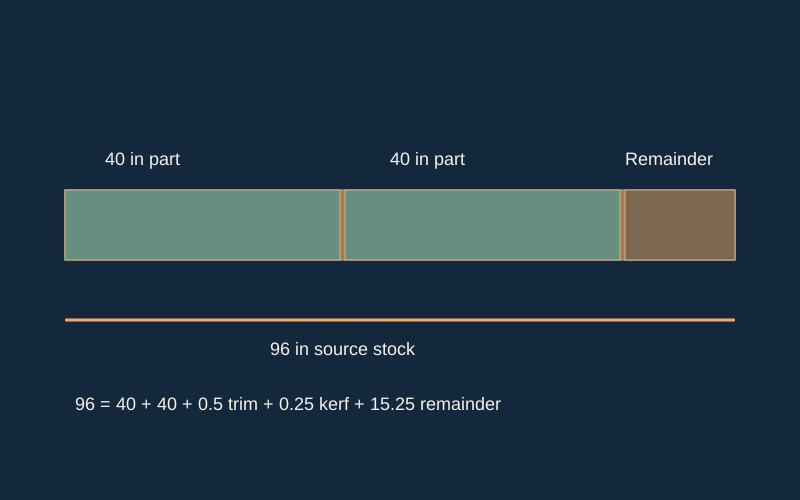
- Worked example: two 40-inch parts from 96-inch stock.
- After 0.5 inch total trim and 0.25 inch total kerf, 15.25 inches remain.
- Bars emphasize the parts; narrow cut losses are enlarged for visibility. Reuse depends on clear length and condition.
Kerf is material removed by the cut
Use a kerf consistent with the actual blade and process. Do not assume the nominal blade body thickness equals the resulting cut width. The planner reserves one kerf for every finished part, including the final part. That intentionally conservative rule may over-allow an exact end fit; it avoids quietly assuming a final cut consumes no material.
End trim is a separate allowance
Trim removes material from the beginning and end of each stock board. Here the entered trim is applied twice per board. It is additional to the per-part kerf allowance. Decide what the trim allowance must cover in the actual process; the program cannot identify split ends, damaged material or an out-of-square end from a number.
- Stock length minus twice end trim gives usable length.
- Each part consumes its finished length plus one kerf.
- Remaining length is shown after both deductions.
Inspect close fits
A plan with almost no remainder deserves attention. Manufacturing variation, measuring error and field changes can make a mathematical fit unusable. This tool uses decimal dimensions and a small floating-point tolerance; its output is not a promise of cutting accuracy. Confirm the plan with the person doing the work before committing expensive stock.
Worked planning example
With 96-inch stock, 0.25-inch trim at each end and 0.125-inch kerf, two 40-inch parts consume 80.25 inches of the 95.5-inch usable length. The remaining 15.25 inches is not another 16-inch part. Both trim and kerf have already been deducted.
Common questions
Why does an exact-length piece fail?
The planner reserves a kerf for that piece. If the part plus kerf is longer than usable stock, it rejects the pattern rather than silently reducing a part.
Is 1/8 inch the correct kerf?
It is a hypothetical default. Replace it with the allowance appropriate to your actual blade, setup and process.
Evidence & limits
- Calculation method: dimensional arithmetic and conservative first-fit packing
- NIST PS 20-25 — measurement, tally and softwood size basis
Reviewed September 13, 2026. Sources support their stated technical principles; this site's workflows and hypothetical examples are not product tests, supplier approvals or independently reviewed project records.