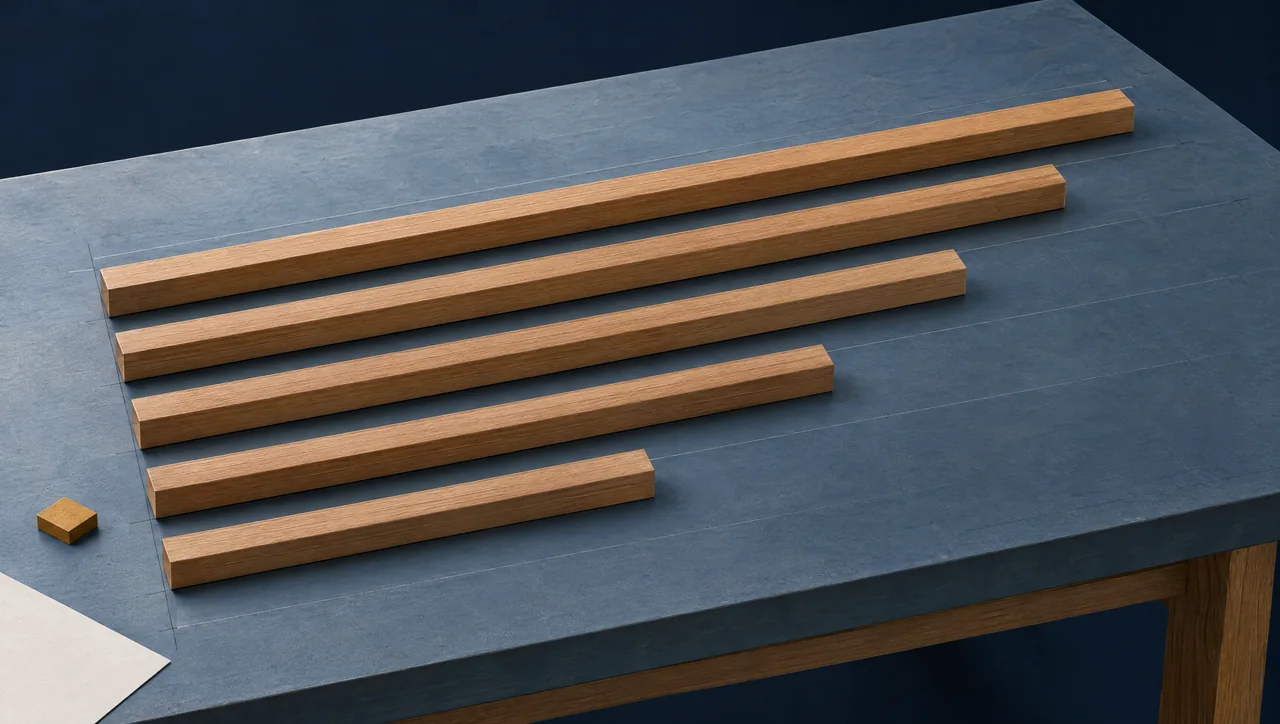
Compare available stock lengths before assigning parts.
Illustrative estimating scene. Use the source drawing, stated dimensions and calculation method for quantities.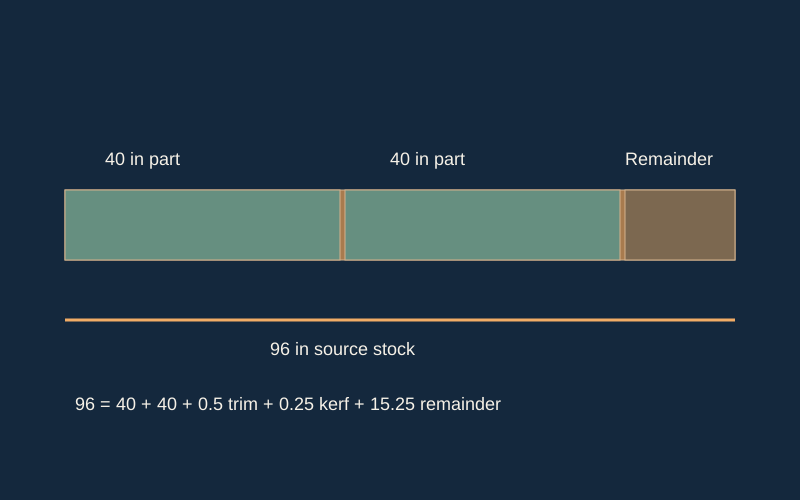
- Worked example: two 40-inch parts from 96-inch stock.
- After 0.5 inch total trim and 0.25 inch total kerf, 15.25 inches remain.
- Bars emphasize the parts; narrow cut losses are enlarged for visibility. Reuse depends on clear length and condition.
Test lengths, not just totals
The available stock length is an input, not a result inferred from the market. Start with lengths confirmed by your supplier, then compare cutting plans for those lengths. A longer board can reduce offcuts in one list and create more unusable remainder in another. It can also change handling, transport and installation constraints.
Compare complete records
The current tool uses one stock length per run. Export a result, change the stock length and export the second result. Compare board count, total purchased length, cut loss, trim and usable offcuts. It does not mix several stock lengths in one optimized search, and the longest-first heuristic does not guarantee the least possible purchase.
- Keep the parts list unchanged when testing a stock alternative.
- Use the same kerf and trimming convention.
- Check availability and purchasing minimums separately.
Do not confuse efficiency with suitability
Grain matching, clear lengths, defects and specified joint locations can invalidate an efficient-looking layout. The shortest purchasing list is not necessarily the best execution plan. Record the reason for selecting a less efficient pattern when it makes the project easier to build or inspect.
Why total linear feet can still leave you short
Forty linear feet of lumber could mean five 8-foot boards, four 10-foot boards or a mixture. Those totals are equal, but they cannot necessarily produce the same finished parts. If the job requires continuous 9-foot pieces, an 8-foot stock selection fails before waste is considered. The first constraint is whether each required piece fits a permitted stock length.
Write a parts schedule with finished length, quantity, profile, face requirements and permitted joints. Keep visually continuous pieces separate from pieces that may be assembled from shorter segments. A cut optimizer cannot decide where a joint is acceptable unless someone supplies that rule. It also cannot assume a short offcut has the correct grain, color or unblemished face for a visible return.
Test the tempting combination with the saw loss included
Suppose a hypothetical job requires twelve pieces at 58 inches. Two of them total 116 inches, suggesting a 120-inch board will work. With 1 inch trimmed from each stock end and one 1/8-inch separating cut, the requirement is 118 1/8 inches. That pattern fits under those stated assumptions. It leaves 1 7/8 inches, not the 4 inches suggested by simply subtracting finished lengths.
Now suppose the parts are 59 inches instead. The same pattern requires 120 1/8 inches and no longer fits. A seemingly trivial length change can double the stock-piece count if no other combinations are available. This is why a percentage allowance cannot rescue an impossible cut pattern. Recalculate when dimensions, trim requirements or the blade kerf change.
The example assumes the specified end trims already describe the material removed by the end-cut operation. If a shop defines trim as a clean finished allowance before the cut, its accounting convention may differ. State the convention once and use it throughout. Do not count a cut twice merely because both the saw operator and estimator have included it.
Compare several feasible purchases
| Candidate | Question to resolve | What the low waste figure may hide |
|---|---|---|
| One stock length | Can every part fit? | Unusable short remnants |
| Mixed stock lengths | Are those lengths actually offered? | Sorting and identification work |
| Longer boards | Can useful short parts share the remainder? | Access, handling and trim restrictions |
| Extra short boards | Which small parts do they supply? | More pieces and more individual cuts |
A good purchase is not automatically the mathematical minimum of leftover length. Compare feasible patterns against availability, order minimums, handling constraints and the effort required to keep pieces organized. Those are purchasing inputs, not reasons to alter a finished part length without authorization.
Release a cut schedule people can follow
Give each repeated pattern an identifier, list its stock length, and state how many boards use it. Label the finished parts by their destination. Keep the original stock label attached to any reusable remainder so a later worker knows its section and usable length. Separate a proposed pattern from the approved cutting instruction.
Before ordering, ask the supplier to confirm the offered length distribution rather than just the total footage. Before cutting, verify the actual stock against the pattern. Use the kerf and end-trim guide when the allowance is uncertain and the offcut record when leftover pieces are part of the plan.
Worked planning example
For ten identical parts, one stock size may fit two parts per board and a slightly longer stock may still fit only two. The additional length then becomes remainder rather than another useful part. Test the exact part-plus-kerf combination before comparing price per foot.
Common questions
Can I enter random-length stock?
Not in one run of this planner. Group available lengths and make separate plans, then manually coordinate remaining parts.
Does the tool know which lengths are in stock?
No. It accepts your input and makes no inventory or availability claim.
Evidence & limits
- Calculation method: dimensional arithmetic and conservative first-fit packing
- NIST PS 20-25 — measurement, tally and softwood size basis
Reviewed September 13, 2026. Sources support their stated technical principles; this site's workflows and hypothetical examples are not product tests, supplier approvals or independently reviewed project records.